Drop a pen. It hits the floor. Simple enough, right?
However, the moment someone asks why — not just "gravity" as a one-word answer, but actually why — things get far more interesting than most people expect.
Because the real answer involves centuries of wrong ideas, one very famous experiment on the Moon, and a number called 9.80 that governs every falling object on Earth.
What Gravity Actually Does
Gravity is the force that pulls all objects toward the center of the Earth. When something is dropped or thrown, that force acts on it immediately and continuously. What this force produces is not speed — it's acceleration. Acceleration means the object's velocity keeps increasing as it falls.
The longer it falls, the faster it goes. On Earth, the acceleration due to gravity has an average value of 9.80 meters per second squared, usually written as g. That means every second an object is in free fall, it picks up another 9.80 meters per second of speed. After one second, it's moving at 9.80 m/s. After two seconds, 19.60 m/s. And so on, unless air resistance or the ground gets in the way first.
The Direction That Defines "Down"
Gravity doesn't just make things fall — it literally defines what we mean by down. "Down" means toward the center of the Earth. Since gravity always pulls in that direction, objects always fall that way, regardless of where on the planet they're standing.
The acceleration due to gravity is directed downward, which is why it's given a negative value when physicists set up equations with upward as positive. A thrown rock heading upward still has a downward acceleration the entire time. Its upward momentum gradually shrinks, stops at the peak, and then reverses into a fall — all because gravity never stopped working.
Why Heavier Objects Don't Fall Faster
For about a thousand years, most people believed Aristotle's claim that heavier objects fall faster than lighter ones. It feels logical.
A bowling ball seems like it should beat a tennis ball to the ground. But Galileo proved this wrong, and the demonstration was later confirmed spectacularly by astronaut David Scott on the Moon in 1971 — where there's no air resistance — dropping a hammer and a feather simultaneously. Both hit the surface at exactly the same time.
The reason is that while a heavier object does experience a greater gravitational force, it also has greater mass to accelerate. These two factors cancel out precisely, so the acceleration — g — is the same for every object regardless of mass or size. A beach ball and a plane would hit the ground at the same time in a vacuum.
The Role of Air Resistance
In the real world, air pushes back against falling objects. This opposing force, called air resistance or drag, is why a feather drifts down slowly while a dense object drops quickly. The lighter and less aerodynamic the object, the more air resistance slows it relative to gravity.
Eventually, a falling object can reach terminal velocity — the point where air resistance exactly balances the gravitational pull, and acceleration stops. Skydivers in free fall reach this point too, which is why they stop speeding up and float at a constant speed rather than falling faster and faster forever.
Free Fall Is Everywhere
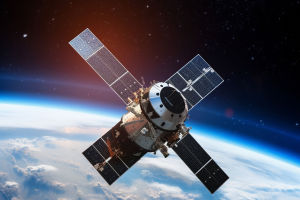
Anything moving solely under gravity's influence is said to be in free fall — whether it's dropping straight down, following the arc of a throw, or orbiting the Earth like a satellite. All of these involve the same g, the same force, the same physics.
Objects don't fall because they're heavy, or because they want to reach the ground, or because the Earth sucks them in. They fall because mass and mass attract each other, and the Earth has an enormous amount of it. Everything else follows naturally from there.