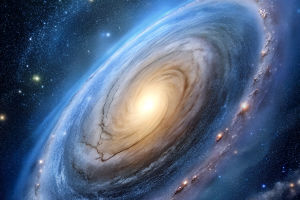
Imagine standing at the center of our galaxy, billions of stars swirling around you, and at the very heart of it all, a massive gravitational pull.
This isn't science fiction—it's the reality of the supermassive black hole sitting at the center of the Milky Way.
Known as Sagittarius A* (pronounced Sagittarius A-star), this black hole has a mass about four million times that of our Sun, yet it's only a few million kilometers wide. Despite being invisible, its effects on the galaxy and beyond are monumental. How does something so invisible manage to influence so much?
What Exactly Is a Supermassive Black Hole?
A supermassive black hole is a type of black hole that contains the mass of millions, or even billions, of stars packed into a single point in space. Unlike the black holes formed by the collapse of stars, supermassive black holes are thought to have grown over billions of years, feeding on gas, dust, and even stars, and influencing the formation of galaxies. They are found at the centers of most large galaxies, including our own.
Key Features of a Supermassive Black Hole:
Event Horizon: This is the "point of no return" around the black hole. Once something crosses it, not even light can escape.
Singularity: At the very center of a black hole is the singularity—a point where the gravitational forces are so intense that time and space lose their meaning.
Massive Influence: Supermassive black holes exert immense gravitational forces on their surroundings, helping to shape the structure of galaxies.
How Do We Know It's There?
You can't see a black hole, but you can see its effects. The supermassive black hole at the center of the Milky Way is invisible, but scientists have gathered evidence of its existence by studying the movement of nearby stars and gas clouds. By tracking the motion of these objects, astronomers can calculate the gravitational pull needed to cause such high-speed orbits. In fact, the discovery of Sagittarius A* has been one of the most important astronomical achievements of the past century.
Evidence for Sagittarius A*:
Star Orbits: Some stars near the center of the galaxy orbit an invisible object with speeds so high that only a supermassive black hole could exert enough gravity to cause such orbits.
X-ray and Radio Waves: Supermassive black holes often emit X-rays and radio waves as they pull in nearby matter. These emissions can be detected by telescopes, providing further evidence of the black hole's presence.
Gravitational Waves: When two massive black holes merge, they release ripples in spacetime known as gravitational waves. Observatories like LIGO have detected these waves, giving us more insight into how black holes interact.
The Role of Sagittarius A* in Galaxy Formation
You might think of black holes as just destructive forces, but they actually play a crucial role in shaping galaxies. The supermassive black hole at the center of the Milky Way, and others like it, are believed to have influenced the formation of the galaxy itself. The energy and material it pulls in can trigger the formation of new stars, or conversely, quench star formation by expelling vast amounts of energy.
How Sagittarius A* Affects the Milky Way:
Regulating Star Formation: The black hole's intense radiation and energy output can regulate the amount of gas available for star formation. It's a delicate balance—too much energy, and new stars are prevented from forming.
Shaping the Galaxy's Structure: The black hole's gravitational pull has influenced the spiral structure of the Milky Way. It helps anchor the galaxy, affecting the movement of stars and other objects.
Feeding on Matter: Sagittarius A* grows by consuming nearby gas, dust, and stars. This accretion process releases energy in the form of radiation, creating powerful jets that influence the interstellar medium.
The Mystery of Black Hole Growth
How did supermassive black holes grow to their current sizes? Scientists still aren't entirely sure. One theory is that they began as smaller black holes, formed after the collapse of massive stars, and gradually grew over time by merging with other black holes or by pulling in matter from their surroundings. Some scientists suggest that they might have formed in the early universe, growing rapidly during the first billion years of the cosmos.
Theories About Supermassive Black Hole Growth:
Accretion of Gas: A common theory is that supermassive black holes grew by steadily pulling in surrounding gas. The material spirals inward, heating up and emitting radiation, which gives us clues about the black hole's activity.
Merging with Other Black Holes: Supermassive black holes might have grown by merging with smaller black holes over time, forming even larger ones. These mergers could be common in dense environments like galaxy centers.
Primordial Formation: Some scientists believe that supermassive black holes could have formed quickly in the early universe from direct collapse, bypassing the slow accretion process.
What's Next in the Search for Black Holes?
While we've learned a lot about supermassive black holes, there's still so much to uncover. New technologies, like the Event Horizon Telescope (EHT), are giving us unprecedented views of black holes, allowing us to "see" the shadow of Sagittarius A* for the first time. As our tools and techniques continue to improve, we may one day answer the question of how these cosmic giants formed and how they influence the evolution of galaxies.
What We Can Look Forward To:
Improved Imaging: Advances in telescope technology will allow us to get clearer and more detailed images of black holes, helping us understand their structure and behavior.
More Gravitational Wave Discoveries: Gravitational wave observatories will continue to detect black hole mergers, providing insight into their growth and interactions.
Understanding the Early Universe: Studying supermassive black holes in distant galaxies may provide clues about the very first black holes that formed after the cosmic dawn.
Black Holes: Guardians of the Galaxy
The supermassive black hole at the center of the Milky Way may be invisible, but its impact on our galaxy is undeniable. It's a cosmic powerhouse, shaping the structure and evolution of the universe itself. As we continue to study these enigmatic giants, we're learning not just about them, but about the forces that govern everything in our universe.
The more we uncover, the clearer it becomes that black holes are far from just destroyers—they are the architects of galaxies.