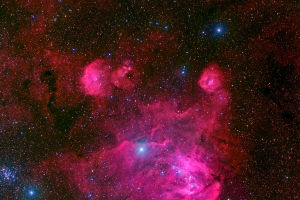
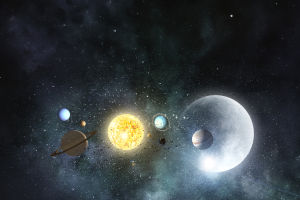
Imagine looking up at the night sky. The stars twinkle, the moon glows, and galaxies swirl in their distant orbits. But what if I told you that more than 95% of the universe is made up of things we can't see?
Dark matter and dark energy are two of the most perplexing mysteries in modern science. They don't emit light, they don't interact with regular matter in ways we can detect directly, but their effects are all around us.
These unseen forces shape the structure and behavior of everything in the cosmos. How do scientists study something so elusive?
Understanding Dark Matter
Dark matter is invisible. It doesn't emit, absorb, or reflect light, making it undetectable with traditional telescopes. Yet, its presence can be inferred through its gravitational effects on visible matter. Without dark matter, galaxies would not hold together the way they do, and stars would fly off into space. It's the glue that holds galaxies, and indeed the entire universe, together.
Key Characteristics of Dark Matter:
Invisible Yet Influential: While we can't see dark matter, we can observe its effects on the motion of galaxies and galaxy clusters. Without it, the universe wouldn't behave the way we see it today.
Doesn't Interact with Light: Unlike ordinary matter, dark matter doesn't interact with electromagnetic radiation (light). This is why it's so hard to detect with traditional telescopes.
Gravitational Pull: Dark matter's primary interaction with the universe is through gravity. It's responsible for the way galaxies rotate and how galaxy clusters hold together despite the fast movement of individual galaxies.
How Scientists Are Looking for Dark Matter:
To avoid interference from cosmic rays and other particles, scientists use detectors deep underground. These detectors aim to catch the rare moments when a dark matter particle might interact with normal matter.
High-energy particle accelerators, such as the Large Hadron Collider, smash particles together at incredibly high speeds. By studying the by-products of these collisions, scientists hope to detect dark matter.
Some experiments use telescopes to study galaxy motions and the distribution of mass. If dark matter is influencing the way these objects behave, it could show up as gravitational anomalies.
The Mystery of Dark Energy
While dark matter is associated with additional gravitational attraction, dark energy is the name given to the mysterious phenomenon associated with the accelerating expansion of the universe. Discovered in the late 1990s, dark energy is thought to make up about 70% of the universe's energy content. Dark energy is the name scientists give to the mysterious phenomenon thought to be responsible for the universe's accelerating expansion. But what exactly is it?
What We Know About Dark Energy:
Dark energy is believed to be the force behind the acceleration of the universe's expansion. Observations of distant Type Ia supernovae in the late 1990s revealed that cosmic expansion is accelerating, an unexpected discovery that led scientists to propose dark energy as an explanation. One theory is that dark energy is a constant force present throughout space. It could be related to the concept of "vacuum energy," a form of energy that exists even in empty space.
Despite its invisibility, dark energy accounts for most of the universe's energy content and shapes its overall structure and fate.
The Tools for Exploring the Unknown
In their search for dark matter and dark energy, scientists rely on a variety of advanced technologies and methodologies. While direct detection remains elusive, astronomers are using innovative tools to study the universe and measure the effects of these invisible forces.
Technologies Used to Study Dark Forces:
Space observatories such as Hubble and Webb contribute measurements relevant to cosmology, while missions such as ESA's Euclid and NASA's Nancy Grace Roman Space Telescope are designed to investigate cosmic structure and the nature of dark energy in much greater detail.
Simulating the behavior of dark matter and dark energy requires immense computing power. Supercomputers help scientists model how these forces interact with visible matter in the universe.
By studying how light from distant stars and galaxies is bent by invisible masses (such as dark matter), scientists can map the presence and distribution of dark matter.
The Future of Dark Matter and Energy Research
The journey to understand dark matter and dark energy is still in its early stages, but the tools and methods continue to evolve. New technologies, larger particle accelerators, and deeper space missions are pushing the boundaries of what we know. With each discovery, scientists get one step closer to understanding the universe's most mysterious components.
What's on the Horizon:
New Space Missions: Upcoming space telescopes and deep space missions will provide more detailed data on the expansion of the universe and the role of dark energy.
Collaboration and Innovation: International collaborations and interdisciplinary research will accelerate breakthroughs in detecting dark matter and dark energy.
Theoretical Models: Advancements in theoretical physics, such as string theory or multiverse hypotheses, could shed light on the nature of dark forces and their role in shaping the cosmos.
A Glimpse Into the Unknown
Dark matter and dark energy represent the ultimate unknowns in our understanding of the universe. These unseen forces have baffled scientists for decades, but with each step forward, we unlock more of the universe's secrets. As technology advances, our understanding of these forces may one day reshape our view of reality itself. Until then, the quest continues, an adventure into the deepest corners of the cosmos where mystery reigns supreme.