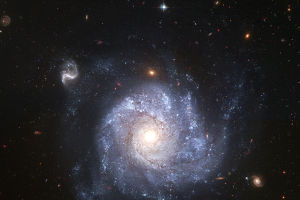
The Large Magellanic Cloud is one of the most fascinating neighboring galaxies of the Milky Way, and it contains a remarkable collection of nebulae.
These enormous clouds of gas and dust come in different shapes and sizes, with many associated with young stars and active regions of stellar formation. Among them are some of the most recognizable deep-space objects, offering a closer look at how stars are born and how their surroundings change.
A Nearby Galactic Neighbor
The Large Magellanic Cloud, often shortened to LMC, is a small galaxy located roughly 160,000 light-years from Earth. It can be observed from the Southern Hemisphere and is much smaller than the Milky Way.
Despite its modest size, the LMC is rich in star-forming regions. Large clouds of gas provide the raw material needed for new stars, while young, energetic stars can influence the surrounding material. This combination makes the galaxy an excellent place to study nebulae and the processes taking place within them.
30 Doradus: A Stellar Giant
One of the most impressive regions in the LMC is 30 Doradus, also known as the Tarantula Nebula. It is one of the largest and most active star-forming regions in the Local Group of galaxies.
30 Doradus contains numerous young stars and enormous concentrations of glowing gas. Powerful radiation from these stars energizes the surrounding material, producing an extensive nebula.
The region is especially important to astronomers because it contains many massive young stars. Studying these stars and their environment helps researchers understand how large stellar groups form and how their energy affects nearby gas.
N44 and Its Complex Structure
Another notable region is N44, a large emission nebula in the LMC. It contains several areas of glowing gas along with cavities and shell-like structures created by energetic processes associated with young stars.
These structures show that nebulae are not static clouds. Over time, radiation and stellar activity can push material outward, creating bubbles and reshaping the surrounding environment.
N44 is particularly useful because its complex structure allows astronomers to examine how young stars interact with the gas around them. Different areas can reveal different stages of this ongoing process.
N11: A Region of Young Stars
N11 is another important star-forming region within the Large Magellanic Cloud. It is one of the largest star-forming complexes in the galaxy and contains multiple concentrations of young stars.
The region includes glowing clouds shaped by radiation from nearby stars. Dense pockets of gas can remain while surrounding material becomes more diffuse, creating an intricate mixture of bright and darker areas.
N11 is valuable for studying how star formation can occur across a large region rather than in one isolated location. The young stars and surrounding clouds provide clues about the conditions that allow new generations of stars to develop.
NGC 1763 and Other Nebulae
The LMC contains many additional nebulae, including NGC 1763, which is associated with a young stellar population and surrounding ionized gas. Objects such as this show that the galaxy's star-forming activity extends far beyond its most famous regions.
Each nebula can have its own structure and history. Some contain compact clusters of young stars, while others feature broad clouds shaped by radiation and stellar activity. Together, they create a detailed picture of the different environments in which stars can form.
Why These Nebulae Matter
Studying nebulae in the LMC gives astronomers an opportunity to investigate star formation in a galaxy outside the Milky Way. Because the LMC is relatively close, individual stars and gas clouds can be examined in considerable detail.
These observations help explain how clouds collapse, how young stars influence their surroundings, and how material is distributed through a galaxy. Comparing several nebulae also reveals that star formation does not follow exactly the same pattern everywhere.
The Large Magellanic Cloud may be smaller than the Milky Way, but its nebulae make it an extraordinary region for astronomical study. From the vast Tarantula Nebula to N44, N11, NGC 1763, and many other glowing clouds, the galaxy contains a variety of environments shaped by young stars and interstellar gas.
Together, these nebulae provide a fascinating view of stellar beginnings. They show that galaxies can remain active places where gas, dust, and young stars continually interact, creating structures that change across immense stretches of time.