Some galaxies are difficult to see not because they are faint, but because something lies in the way. IC 342 is a perfect example. This large spiral galaxy is relatively close to the Milky Way, yet much of its light is obscured by gas and dust within our own galaxy.
That is why IC 342 has earned the nickname the Hidden Galaxy, beneath this veil is an active and fascinating galaxy filled with stars, glowing regions, and a busy central area.
Where Is IC 342?
IC 342 is located in the constellation Camelopardalis, in the northern sky. Astronomers estimate that it lies roughly 10 million light-years from Earth, making it one of the closer large galaxies beyond our immediate galactic neighborhood.
Its position is especially important to its story. IC 342 sits relatively close to the plane of the Milky Way. From Earth's viewpoint, the galaxy is seen through a thick region containing stars, gas, and dust belonging to our own galaxy.
This material blocks and scatters some of IC 342's light before it reaches Earth. As a result, the galaxy appears much fainter and less prominent than its actual size and activity might suggest.
A Large Spiral Galaxy
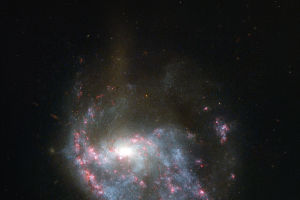
IC 342 is classified as a spiral galaxy, meaning it has a broad disk with curved arms extending from a central region. Its overall structure resembles other large spiral galaxies, including the Milky Way.
The galaxy has an active central area surrounded by spiral arms containing numerous stars and clouds of gas. These regions provide the material and conditions needed for new stars to form.
Because dust within the Milky Way makes visible-light observations difficult, astronomers often rely on other wavelengths to study IC 342. Infrared observations are particularly useful because infrared light can pass through some of the dust that blocks visible light.
A Busy Central Region
One of IC 342's most interesting features is its central region. Astronomers have found evidence of significant star-forming activity there, making the galaxy an important object for studying how stars develop in a spiral galaxy.
The central area contains large amounts of gas, which can provide raw material for new stars. Young stars then release energy into their surroundings, influencing the nearby gas and contributing to the changing structure of the region.
Why Is It Called the Hidden Galaxy?
The nickname comes directly from the challenge of observing IC 342 through the Milky Way's dusty plane. The galaxy itself is not truly hidden in space. Instead, its light is partially concealed from Earth's viewpoint.
This makes IC 342 an interesting example of how astronomy depends on more than simply having a powerful telescope. The location of an object relative to Earth can strongly affect what can be observed.
If IC 342 were viewed without the interference caused by material in the Milky Way, its structure and brightness would be much easier to study. Astronomers therefore use observations at different wavelengths to reveal information that visible light alone cannot provide.
A Neighbor Worth Studying
IC 342 belongs to the broader group of galaxies surrounding the Milky Way. Its relatively short astronomical distance makes it useful for studying galaxy structure and star formation outside our own galaxy.
Because it is both large and comparatively nearby, IC 342 offers researchers a valuable opportunity to examine how a spiral galaxy functions. Its star-forming regions, central activity, and extended disk provide several areas for investigation.
What Makes IC 342 Special?
IC 342 stands out because its appearance from Earth does not fully reveal what lies beyond the Milky Way's dusty foreground. It is a substantial spiral galaxy with active regions that would attract attention even without its unusual observational challenge.
Its story is also a useful reminder that space can be difficult to study for unexpected reasons. Sometimes the challenge is not distance but the material between an astronomical object and the observer.
IC 342 deserves its reputation as the Hidden Galaxy because much of its light must travel through the dusty regions of the Milky Way before reaching Earth. Yet behind that obstruction is a large spiral galaxy with active star-forming regions and a fascinating central structure.
By observing IC 342 across different wavelengths, astronomers can look beyond the material that makes it difficult to see. The galaxy remains a valuable nearby example of how much more there is to learn when the universe is viewed from different perspectives.